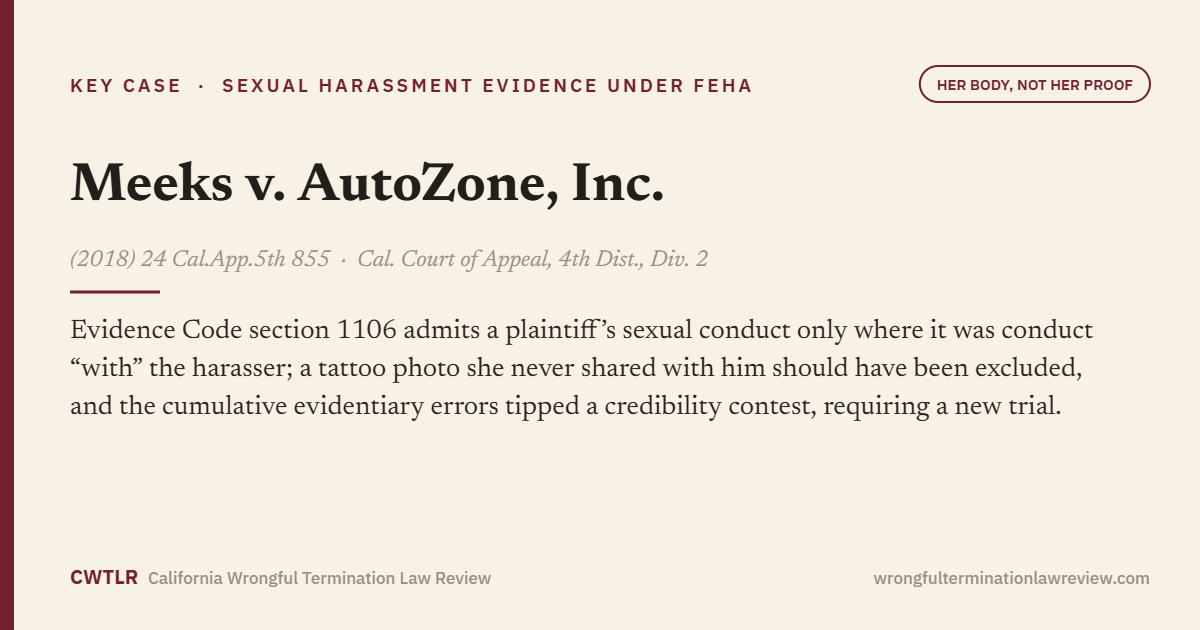
Meeks v. AutoZone, Inc.
A new trial for a FEHA harassment plaintiff after the court let in her body but kept out her proof — and a working map of Evidence Code section 1106’s reach over the “subjectively offensive” element.
Meeks v. AutoZone, Inc. (2018) 24 Cal.App.5th 855
Harassment
Hostile work environment
FEHA (Gov. Code § 12940)
In brief. The Court of Appeal reversed defense jury verdicts on a sexual harassment plaintiff’s FEHA claims, holding that a series of evidentiary rulings cumulatively skewed a credibility contest in the defense’s favor. Most consequentially, the court held that Evidence Code section 1106, subdivision (a) barred publication to the jury of a years-old photograph of the plaintiff’s lower-abdomen tattoo, because the photograph was not “sexual conduct ‘with’” the alleged harasser within the subdivision (b) exception. (Meeks, supra, 24 Cal.App.5th at p. 875.) The court separately affirmed summary adjudication of the retaliation claim, holding that a single, never-carried-out threat is not an adverse employment action. (Id. at pp. 878–879.)
By Jonathan J. Delshad
Founder & Editor-in-Chief
Facts
The California Fair Employment and Housing Act makes it an unlawful employment practice for an employer, because of sex, to harass an employee, and to fail to take all reasonable steps necessary to prevent harassment from occurring. (Gov. Code, § 12940, subds. (j)(1), (k).) To be actionable as a hostile work environment, the conduct must amount to “a pattern of continuous, pervasive harassment,” giving rise to an environment that is “both objectively and subjectively offensive.” (Meeks, supra, 24 Cal.App.5th at p. 874.)
AutoZone hired Natasha Meeks as a customer sales representative in March 2006; through a series of promotions she became a store manager, a role she still held when she testified at trial in May 2014. (Meeks, supra, 24 Cal.App.5th at p. 859.) AutoZone hired Juan Fajardo in 2005, and he too rose to store manager. (Ibid.) Meeks and Fajardo were never assigned to the same store, but they had regular contact during inventories, when visiting one another’s stores for parts, and by telephone on an almost daily basis in connection with “stock checks.” (Ibid.)
According to Meeks, Fajardo “regularly subjected her to sexual harassment in various forms,” commenting on her body and clothes, asking her out, and suggesting they have sex; sending her text messages with sexual content, including images and video; and, on three occasions, forcibly attempting to kiss her, succeeding once in pressing his lips to hers despite her efforts to push him away. (Meeks, supra, 24 Cal.App.5th at pp. 859–860.) He suggested he could facilitate her advancement through his standing as a “favorite” of the district manager, and told her he would get her fired if she reported his conduct. (Id. at p. 860.)
Meeks first reported Fajardo’s conduct in October 2009 to district manager Susana Ledesma, who supervised both employees. (Meeks, supra, 24 Cal.App.5th at p. 860.) Ledesma reported back that Fajardo had “‘just … kind of laughed it off,’” and, according to Meeks, told her she should “just squash it” because Ledesma did not want to “lose three managers.” (Ibid.) Meeks testified that Ledesma later threatened to fire Meeks and her husband if Meeks took her complaints “higher.” (Ibid.) AutoZone’s human resources department did not contact Meeks until August 2010, ten months later. (Ibid.) AutoZone terminated Fajardo in September 2010, stating it did so because he admittedly sent a text message with sexual content to another employee, Amanda Anguiano. (Ibid.)
Procedural history
Meeks sued AutoZone and Fajardo in September 2010; her operative first amended complaint pleaded sexual harassment (hostile work environment) against both defendants, failure to prevent harassment and retaliation against AutoZone only, retaliation against AutoZone only, and sexual battery against both defendants. (Meeks, supra, 24 Cal.App.5th at p. 860.) The trial court (Judge Edward D. Webster) granted summary adjudication for AutoZone on the retaliation claim, and during trial Meeks dismissed her sexual battery claim. (Id. at pp. 860–861 & fn. 1.) A jury returned defense verdicts on the remaining claims, answering “no” to the special verdict question whether Meeks had proved she “was subjected to unwanted harassing conduct because she is a woman.” (Id. at p. 861.)
Both sides appealed. Meeks challenged the trial court’s evidentiary rulings and the summary adjudication of her retaliation claim. (Meeks, supra, 24 Cal.App.5th at p. 859.) The Court of Appeal affirmed the summary adjudication but reversed the judgment on the remaining claims, finding that several erroneous evidentiary rulings were not harmless, and remanded for a new trial. (Ibid.)
Issue
The appeal presented two clusters of questions. First, whether the trial court abused its discretion by (a) barring Meeks from testifying to the specific contents of unavailable text messages she received from Fajardo; (b) excluding the bulk of her proffered “me-too” evidence of Fajardo’s conduct toward other female employees; and (c) permitting the defense to publish a photograph of her lower-abdomen tattoo — and, if so, whether those errors were prejudicial under People v. Watson. (Meeks, supra, 24 Cal.App.5th at pp. 861, 877.) Embedded in that cluster is the substantive question that gives the case its doctrinal value: how Evidence Code section 1106 governs evidence of a harassment plaintiff’s own sexual conduct offered to disprove the “subjectively offensive” element. (Id. at pp. 874–875.) Second, whether a single threat of an adverse employment action, never carried out, can itself constitute an adverse employment action supporting a FEHA retaliation claim. (Id. at pp. 878–879.)
Holding
The court held that the trial court abused its discretion in three respects — excluding Meeks’s detailed testimony about the text messages, excluding her me-too evidence of Fajardo’s conduct toward others, and publishing the tattoo photograph — and that the cumulative effect was prejudicial under the Watson standard, requiring reversal and a new trial on the harassment and failure-to-prevent claims. (Meeks, supra, 24 Cal.App.5th at pp. 877–878.) On the tattoo, the court held that the photograph fell within the broad meaning of “sexual conduct” under section 1106 but was not “conduct with” Fajardo, so the general exclusion of subdivision (a) applied and the subdivision (b) exception did not. (Id. at p. 875.) The court held that summary adjudication of the retaliation claim was proper because a single, uncarried-out threat is not an adverse employment action. (Id. at pp. 878–879.) The court expressly declined to decide whether each item of me-too evidence was individually admissible, or whether a redacted version of certain documents could have been admitted. (Id. at pp. 872–873, 877.)
Reasoning
Secondary-evidence and hearsay objections did not justify silencing the plaintiff about the texts. The court began with the rulings barring Meeks from describing the contents of Fajardo’s text messages, which she no longer possessed. Under section 1521, the content of a writing may be proved by otherwise admissible secondary evidence, and exclusion is required only where a genuine dispute exists concerning material terms and justice requires exclusion, or admission would be unfair. (Meeks, supra, 24 Cal.App.5th at p. 863.) Section 1523 permits oral testimony to prove a lost writing’s content where the proponent lacks the original or a copy, the original was lost or destroyed without fraudulent intent, and the writing was not reasonably procurable. (Ibid.) Those conditions were met: no one challenged that Meeks lacked the texts and could not procure them, the trial court rejected AutoZone’s spoliation claim, and it made no finding of fraudulent intent. (Id. at p. 864.) The trial court’s stated worry about “pure speculation” misfired, the court reasoned, because Meeks’s memories of the texts were “no more speculation than her memories of things Fajardo said to her, or his physical actions towards her,” and verbatim recall is not required. (Ibid.)
The second judge expanded the restriction without doing the balancing the law requires. The court underscored a procedural defect: Judge Taylor would have allowed Meeks to describe “other aspects” of the messages, including the pictures and videos, while barring only word-for-word recitation, but Judge Marquez — purporting only to “essentially affirm” that ruling — in fact prohibited any specific testimony about attached photos or visual media, relying on the “mistaken proposition” that the relevant section 1521 analysis had already been performed. (Meeks, supra, 24 Cal.App.5th at pp. 864–865.) The broader restriction thus issued “without any judicial officer ever having specifically considered whether justice required those broader restrictions.” (Id. at p. 865.) The court rejected the defense’s fairness argument that it could not challenge Meeks’s account: nothing stopped Fajardo from giving his own testimony and cross-examining her, and “he said/she said contests” are routine in harassment trials, with credibility “the exclusive province of the trier of fact.” (Ibid.) The hearsay objection failed because Meeks’s testimony — for example, that Fajardo sent an image with the words “‘we should try this’” — was offered not for its truth but as “operative facts” showing the messages were sent and were offensive. (Id. at pp. 865–866.)
Me-too evidence was admissible against the individual harasser, not just the employer. Turning to the excluded testimony of other female employees, the court reaffirmed that “me-too” evidence of gender bias toward nonparty employees is not subject to any per se rule of exclusion and may prove a defendant’s motive or intent even when the conduct occurred outside the plaintiff’s presence. (Meeks, supra, 24 Cal.App.5th at p. 871, citing Pantoja v. Anton (2011) 198 Cal.App.4th 87 and Johnson v. United Cerebral Palsy/Spastic Children’s Foundation (2009) 173 Cal.App.4th 740.) The trial court erred by instructing the jury to disregard Fajardo’s conduct unless Meeks was a “party” to it and to consider me-too evidence only against AutoZone; that reflected “a misunderstanding of the law” that infected both its admissibility rulings and its section 352 weighing. (Id. at p. 872.) The court rejected the defense argument that Fajardo, unlike the defendant in Pantoja, had not put his intent in issue: a hostile-environment claim still requires proof of discrimination because of sex, and Fajardo “repeatedly insist[ed] that he treated male and female employees similarly,” so Meeks was “entitled to prove otherwise.” (Id. at pp. 872–873.) The court did not decide whether each item should have been admitted; it was “enough to conclude that the analysis of probative value apparently applied by the trial court was erroneous.” (Id. at p. 873.)
Section 1106 admitted Fajardo’s account of the plaintiff’s sexual banter but barred the tattoo photograph. The doctrinal heart of the opinion addressed evidence of Meeks’s own sexual conduct. Section 1106, subdivision (a) bars a defendant from using opinion, reputation, and specific-instance evidence of a plaintiff’s sexual conduct “to prove consent by the plaintiff or the absence of injury,” but subdivision (b) carves out “evidence of the plaintiff’s sexual conduct with the alleged perpetrator.” (Meeks, supra, 24 Cal.App.5th at p. 874.) “Sexual conduct” is broadly construed to include “‘all active or passive behavior … that either directly or through reasonable inference establishes a plaintiff’s willingness to engage in sexual activity,’” including “‘racy banter, sexual horseplay, and statements concerning prior, proposed, or planned sexual exploits.’” (Ibid.) Under that standard, Fajardo’s testimony that Meeks discussed intimate matters with him in a sexually explicit manner was admissible under subdivision (b) as conduct “with” him; Meeks’s denial created only a factual dispute for the jury, and her point that such talk does not equal consent to groping or explicit texts went to weight. (Id. at pp. 874–875.) The court also rejected Meeks’s procedural argument under section 783, which governs sexual-conduct evidence offered to attack credibility, because here the evidence went to consent and absence of injury under section 1106, subdivision (b), not credibility. (Id. at p. 875.) The tattoo photograph, however, fell on the other side of the line. Although the act of taking and sharing a photograph of a lower-abdomen tattoo “likely falls within the broad scope” of sexual conduct, neither the photograph nor Meeks’s 2006 decision to post it to social media was “‘conduct with’ Fajardo in any respect,” so subdivision (a)’s general exclusion controlled. (Ibid.) The court added that the photograph had no impeachment value, since Meeks never denied having the tattoo, and the 2006 post in fact contradicted Fajardo’s account of a 2009 or 2010 conversation about a tattoo she was “planning on getting.” (Ibid.)
Two defense-favorable rulings survived, one on waiver. The court engaged and rejected several of Meeks’s other attacks. It found no abuse of discretion in excluding detailed evidence of a former employee’s (Olson’s) harassment by a different manager, because Meeks’s knowledge was secondhand and admitting it risked “a trial within a trial.” (Meeks, supra, 24 Cal.App.5th at pp. 867–868.) And it held that Meeks forfeited her challenge to the exclusion of AutoZone’s investigation “Q and A” statements by failing to attack the trial court’s independent section 352 ground; even reaching the merits, the documents — referencing some 37 individuals — could properly be excluded as confusing and time-consuming. (Id. at pp. 876–877.)
The errors cumulatively skewed a credibility contest. On prejudice, the court applied the Watson reasonably-probable standard. (Meeks, supra, 24 Cal.App.5th at p. 877.) Because Meeks could not describe the texts, the jury “had no basis to evaluate whether a reasonable person would share her view that they were offensive,” and the excluded me-too evidence “undermined one of her strongest attacks” on Fajardo’s “family stuff” defense. (Id. at pp. 877–878.) Echoing Pantoja, the court observed that the rulings “skew[ed] the evidence”: Fajardo testified in detail about Meeks’s purported sexual statements while she was confined to “sanitized terms,” and the defense published “a revealing photograph of Meeks’s body … of minimal, if any, relevance.” (Id. at p. 878.) In “essentially a ‘credibility contest,’” the errors “cumulatively may well have unfairly ‘tipped the balance’ in favor of the defense.” (Ibid.)
The retaliation claim failed for want of an adverse action. Reviewing the summary adjudication de novo, the court applied the Yanowitz prima facie framework, which requires protected activity, an adverse employment action, and a causal link. (Meeks, supra, 24 Cal.App.5th at p. 878.) There was no evidence AutoZone took any adverse action: Meeks remained a store manager through trial, with no loss of classification, position, salary, benefits, or hours. (Id. at pp. 878–879.) Ledesma’s threat to fire Meeks and her husband if she did not “squash” her complaint was never carried out, and Meeks identified “no authority … holding that a single threat of an adverse employment action, never carried out, could itself constitute an adverse employment action.” (Id. at p. 879.) The concurrence by Presiding Justice Ramirez and Justice McKinster was without separate opinion. (Id. at p. 879.)
Significance
Meeks is a practical anchor for litigating the “subjectively offensive” element in FEHA harassment cases and the operation of Evidence Code section 1106. Its most portable rule is the section 1106 “conduct with the alleged perpetrator” line: evidence of a plaintiff’s sexual conduct directed at or shared with the harasser may come in under subdivision (b), but the same category of evidence that has no connection to the harasser — here, a privately posted photograph predating the parties’ acquaintance — remains barred by subdivision (a). (Meeks, supra, 24 Cal.App.5th at pp. 874–875.) The opinion also clarifies, building on Pantoja, that a harasser places his discriminatory intent in issue simply by defending on the theory that he treated everyone the same, opening the door to me-too evidence against the individual defendant and not merely the employer. (Id. at pp. 872–873.) On the secondary-evidence point, the case is a useful counter to motions in limine that would silence a plaintiff about lost electronic communications; recollection of substance, not verbatim text, suffices. (Id. at p. 864.) Its limits are real: the court resolved no item-by-item admissibility questions, left intact the trial court’s discretion to exclude attenuated third-party and investigation evidence under section 352, and did not disturb the rule that an uncarried-out threat is not an adverse employment action. (Id. at pp. 867–868, 873, 876–877, 879.) Because the Supreme Court denied review, the opinion stands as published, citable authority. (Id. at p. 879.)
Key quotes
“Her memories of electronic communications from Fajardo are no more speculation than her memories of things Fajardo said to her, or his physical actions towards her.” (Meeks, supra, 24 Cal.App.5th at p. 864.)
“But neither the photograph itself, nor Meeks’s 2006 decision to publish it to social media, was ‘conduct with’ Fajardo in any respect, so as to fall within section 1106, subdivision (b). As such, the general exclusion provided by section 1106, subdivision (a), applies to the photograph at issue.” (Id. at p. 875.)
“Here, as in Pantoja, the trial was essentially a ‘credibility contest,’ and the trial court’s errors cumulatively may well have unfairly ‘tipped the balance’ in favor of the defense.” (Id. at p. 878.)
Practice pointer
When the defense seeks to introduce evidence of a harassment plaintiff’s sexual conduct, force the section 1106, subdivision (b) question to the front: is this conduct “with the alleged perpetrator,” or is it conduct in the world that the defendant has merely discovered? Build the record on that distinction. Subdivision (a) presumptively excludes opinion, reputation, and specific-instance evidence of the plaintiff’s sexual conduct offered to show consent or absence of injury; only conduct directed at or exchanged with the harasser escapes through subdivision (b). For plaintiffs, that means objecting to social-media images, third-party relationships, and prior history that never touched the defendant, and resisting the defense’s instinct to recharacterize section 1106 evidence as “credibility” evidence to trigger section 783 instead. For defendants, it means tying any such evidence to the harasser through testimony of direct interaction. And on lost texts, plaintiffs should lay the section 1523 foundation (no possession, no fraudulent intent, not reasonably procurable) and be ready to testify to the substance of the messages; do not concede that imperfect recall equals “speculation.” (Meeks, supra, 24 Cal.App.5th at pp. 864, 874–875.)
Open questions
The court expressly reserved several issues. It “need not and [did] not opine whether each item of me-too evidence proffered by Meeks should have been admitted, or whether some could reasonably have been excluded pursuant to section 352 even applying an appropriate analysis of its probative value.” (Meeks, supra, 24 Cal.App.5th at pp. 872–873.) On the excluded investigation documents, the court “express[ed] no opinion about whether the trial court could have exercised its discretion differently, for example, by admitting a limited or redacted portion of the statements.” (Id. at p. 877.) And on retaliation, the court left open how the law would treat threats other than a single uncarried-out one, noting only that no authority supported treating that lone threat as an adverse employment action. (Id. at p. 879.) The opinion also does not resolve where the section 1106 line falls for conduct that is shared with the harasser only indirectly — a recurring question its “conduct with” framing will continue to generate.